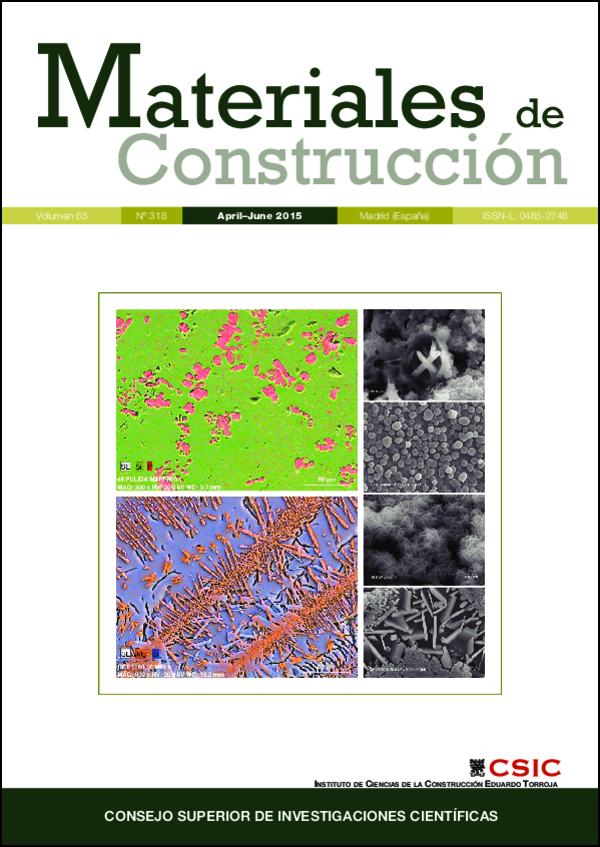
Materiales utilizados en la policromía de la fachada de Pedro I (Real Alcázar de Sevilla, España)
DOI:
https://doi.org/10.3989/mc.2015.04314Palabras clave:
Policromía, Pigmento, Aglutinante, Técnicas, CaracterizaciónResumen
El estudio de la fachada del palacio de Pedro I ha puesto de manifiesto la existencia de un gran número de policromías realizadas con una amplia variedad de pigmentos de diferentes cronologías. Mediante diversas técnicas analíticas han sido diferenciadas y caracterizadas química y mineralógicamente. El estudio estratigráfico detallado de las diferentes policromías ha permitido relacionarlas con las sucesivas intervenciones documentadas, comprobando así la gran importancia que el color ha tenido en todas las épocas o momentos históricos del Palacio.
Descargas
Citas
1. Martín-Ramos, J.D. (2004) Using Xpowder a sofware package for powder X-ray diffraction analysis. D.L. GR-1001/04; ISBN:84-609-1497-6, Spain. http://www.xpowder.com.
2. Down, R.T. (2006) The RRUFF Project: an integrated study of the chemistry, crystallography, Raman and infrared spectroscopy of minerals. Program and Abstracts 19th General Meeting International Mineralogical Association, Kobe, Japan. O03-13. http://rruff.info/.
3. Castro, K.; Pérez-Alonso, M.; Rodríguez-Laso, M.D.; Fernández, L.A.; Madariaga, J.M. (2005) On-line FT-Raman and dispersive Raman spectra database of artist´ materials (e-VISART database). Anal. Bioanal. Chem. 382, 248–258. http://dx.doi.org/10.1007/s00216-005-3072-0
4. Bell, I.M.; Clark, R.J.H.; Gibbs, P.J. (1997) Raman spectroscopic library of natural and synthetic pigments (pre 1850 AD). Spectrochimica Acta Part A 53, 2159–2179. http://dx.doi.org/10.1016/S1386-1425(97)00140-6
5. Bersani D.; Lottici P.P.; Casoli A.; Cauzzi D. (2008) Pigments and binders in "Madonna col Bambino e S. Giovannino" by Botticelli investigated by micro-Raman and GC/MS. J. Cult. Herit. 9, 97–102. http://dx.doi.org/10.1016/j.culher.2007.05.005
6. Halpine, S. (1992) Amino acid analysis of proteinaceous media from Cosimo Tura's The Annunciation with Saint Francis and Saint Louis of Toulouse. Studies in Conservation 37, 22–38.
7. Gettens, R.J.; FitzHugh, E.W.; Feller, R.L. (1993) Calcium carbonate whites. In: Artists' pigments: A handbook of their history and characteristics. Vol. 2, A. Roy (ed.). D.C. National Gallery of Art Washington, Oxford Univ. Press, 203–226.
8. Eastaugh, N.; Walsh, V.; Chaplin, T.; Siddal, R. (2004) The pigment compendium. Optical microscopy of historical pigments. Elsevier, Amsterdan.
9. Bearn, J.G. (1923) The Chemistry of paints, pigments and varnishes. Ernest Benn Ltd, London.
10. Jaró, M.; Kriston, L. (1987) L'Analyse des piments bruts romains découberts a Baláca. 8th triennial Meeting. Sydney. Australia. Vol. 2. ICOM Committee for Conservation. 763–764.
11. Kühn, H. (1993) Lead-Tin Yellow. In: Artists' pigments: A handbook of their history and characteristics. Vol. 2, A. Roy (ed.). D.C. National Gallery of Art Washington, Oxford Univ. Press, 83–112.
12. FitzHugh, E.W. (1986) Red lead and minium. In: Artists' pigments: A handbook of their history and characteristics. Vol. 1, R.L. Feller (ed.). D.C. National Gallery of Art Washington, Oxford Univ. Press, 109–139.
13. Gettens, R.J.; FitzHugh, E.W. (1993) Azurite and blue verditer. In: Artists' pigments: A handbook of their history and characteristics. Vol. 2, A. Roy (ed.). D.C. National Gallery of Art Washington, Oxford Univ. Press, 23–35.
14. Plester, J. (1993) Ultramarine blue, natural and artificial. In: Artists' pigments: A handbook of their history and characteristics. Vol. 2, A. Roy (ed.). D.C. National Gallery of Art Washington, Oxford Univ. Press, 37–65.
15. Matteini, M.; Moles, A. (2008) La química en la restauración. Los materiales del arte pictórico. (2ª ed). Nerea, San Sebastián.
16. Fiedler, I.; Bayard, M. (1997) Emerald green and Scheele's green. In: Artists' Pigments: A handbook of their history and characteristics. Vol. 3, E.W. FitzHugh (ed.). D.C. National Gallery of Art Washington, Oxford Univ. Press, 219–272.
17. Chávez González, M.R. (2004) El Alcázar de Sevilla en el siglo XIX. Patronato del Real Alcázar de Sevilla, Sevilla. PMid:15120942
Publicado
Cómo citar
Número
Sección
Licencia
Derechos de autor 2015 Consejo Superior de Investigaciones Científicas (CSIC)

Esta obra está bajo una licencia internacional Creative Commons Atribución 4.0.
© CSIC. Los originales publicados en las ediciones impresa y electrónica de esta Revista son propiedad del Consejo Superior de Investigaciones Científicas, siendo necesario citar la procedencia en cualquier reproducción parcial o total.
Salvo indicación contraria, todos los contenidos de la edición electrónica se distribuyen bajo una licencia de uso y distribución “Creative Commons Reconocimiento 4.0 Internacional ” (CC BY 4.0). Consulte la versión informativa y el texto legal de la licencia. Esta circunstancia ha de hacerse constar expresamente de esta forma cuando sea necesario.
No se autoriza el depósito en repositorios, páginas web personales o similares de cualquier otra versión distinta a la publicada por el editor.